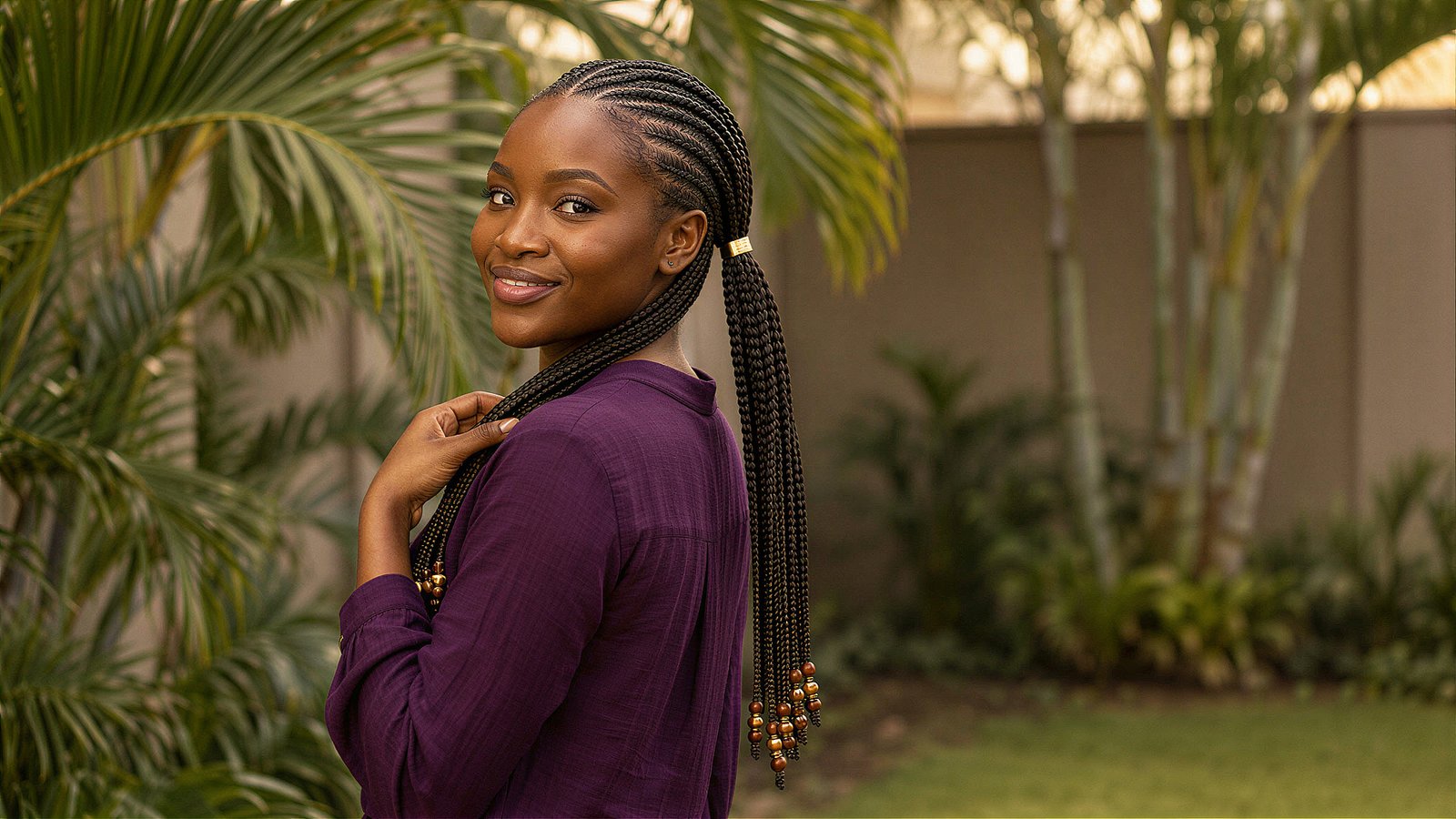
Fulani braids are a West African protective style built around a central cornrow or centre part, side cornrow sections angled away from the centre line, and free-hanging braids at the back. The name describes a section pattern and a bead-and-shell language rather than one fixed look, so two Fulani sets can share a front and finish completely differently.
That matters at the booking stage: the central cornrow is the foundation of the style, so the front section is worth agreeing in detail before the appointment (Aunt Jackie’s). This guide covers the structure, the styles worth naming, the hair to buy, how long the style lasts and what it costs in Ghana and the US.
Key takeaways
- The signature is one central braid from the front hairline to the nape, side cornrows angled outward, and a free-hanging back.
- The back is a choice: straight, curled, jumbo, thin, twists or knotless.
- US full sets typically run $100–$350, with New York City at $200–$450+ (checked November 2026).
- Unruly puts wear at 4–6 weeks, and smaller braids outlast jumbo ones.
- Confirm whether hair and beadwork sit inside the quote before you pay a deposit.
Source: Cost of Fulani Braids: NYC to LA, How Much Is Too Much? — Unruly, Checked November 2026
What are Fulani braids — and what are they not?
Fulani braids are defined by their parting: one central braid runs from the front hairline to the nape, side cornrows angle away from that line, and the back hangs free as braids (Aunt Jackie’s). Length, thickness, curls and beads are decisions layered on top of that structure.
The style is traced to the Fulani (Fulbe) people, whose communities sit across West and Central Africa. The sources name Senegal, Mali, Guinea and Nigeria; Ghana is not on that list, so be careful with anyone who tells you the style "belongs" to one country. Braiding carried identity, heritage and status meaning in Fulani culture, which makes it heritage rather than a trend cycle (Wikipedia).
Stylists improvise well beyond the classic, with swoops, crisscrosses and zig-zag parts still counted as Fulani. Even the central cornrow can be replaced by a plain middle part (Unruly). There is no single fixed Fulani pattern (Unruly).
The central cornrow and side sections
The central cornrow is the foundation of the whole style, so it is the first thing to agree with your braider (Aunt Jackie’s). Side cornrows run outward from the centre line, and a common layout adds one cornrow each side of the face plus a braid following the hairline.
Where the cornrows end, the back is left to you. Straight, curled, jumbo or thin back sections all belong to the family (Aunt Jackie’s).
Fulani braids vs tribal, micro and knotless braids
Most confusion comes from using a pattern, an umbrella term, a size and a technique in the same sentence.
| Term | What it describes | How to tell |
|---|---|---|
| Fulani braids | A section pattern: centre braid, side cornrows, free back | Look at the parting and the front, not the length |
| Tribal braids | An umbrella label for many African braided styles, Fulani included | If a braider says "tribal", ask which pattern |
| Micro braids | A size: very thin individual braids across the head | A thickness, not a style |
| Knotless braids | A root technique with no knot at the base | Can be the back of a Fulani set |
| Box braids | A back-braid option in some Fulani sets | Check the front and back finish |
Unruly uses "tribal braids" as a synonym for Fulani, and that is the conflation to correct: tribal is the umbrella, Fulani is one pattern inside it (Unruly). Micro is a size, not a style, and small or micro Fulani braids cost more because they take longer and demand precision (Unruly). Knotless is a feed-in method that removes the knot at the root, and it can run through the back of a Fulani set without changing the front (Booksy).
Fulani braid styles to ask for, from classic to curls

The front stays recognisably Fulani across every option below; what you change is the back, the length and the adornment.
| Style | What to ask for | Best for |
|---|---|---|
| Classic centre-part | One middle cornrow, side cornrows each side, box braids or twists at the back | Church, work, weddings |
| With curls | Cornrows as normal, curly ends left loose | A softer, face-framing finish |
| Short | Chin to shoulder length | Quick-install, low-upkeep option |
| Knotless back | Feed-in roots at the back, no knot | Sensitive scalps |
| Twist variation | Two-strand or Senegalese-style twists at the back | A different back finish |
| Men’s | Centre part, small side cornrows, braided or loose back | Work and occasions |
With curls
Fulani braids with curls keep the cornrows as normal and add curly human hair or curly extensions at the ends, sometimes sold as a goddess finish (Unruly). The result frames the face and leaves loose curls at the ends.
Short, knotless and twist variations
Shoulder length is the quick-install, low-upkeep option, and short Fulani braids read sharp for work (Unruly). Knotless roots are recommended for sensitive scalps because they reduce tension at the base (Ywigs). Two-strand twists can replace the braided back while the front sections stay intact.
Fulani braids for men
Men wear the same map with a centre part, smaller side cornrows and a braided or loose back, kept neat for work and occasions. The sources checked for this guide give no men’s pricing, so ask for a quote on your own length and size.
For weddings, church and outdoorings, keep the adornment deliberate: a line of gold beads at the ends, or a few cowries at the back, reads more considered than a full cluster.
Beads, cowrie shells and adornment done comfortably
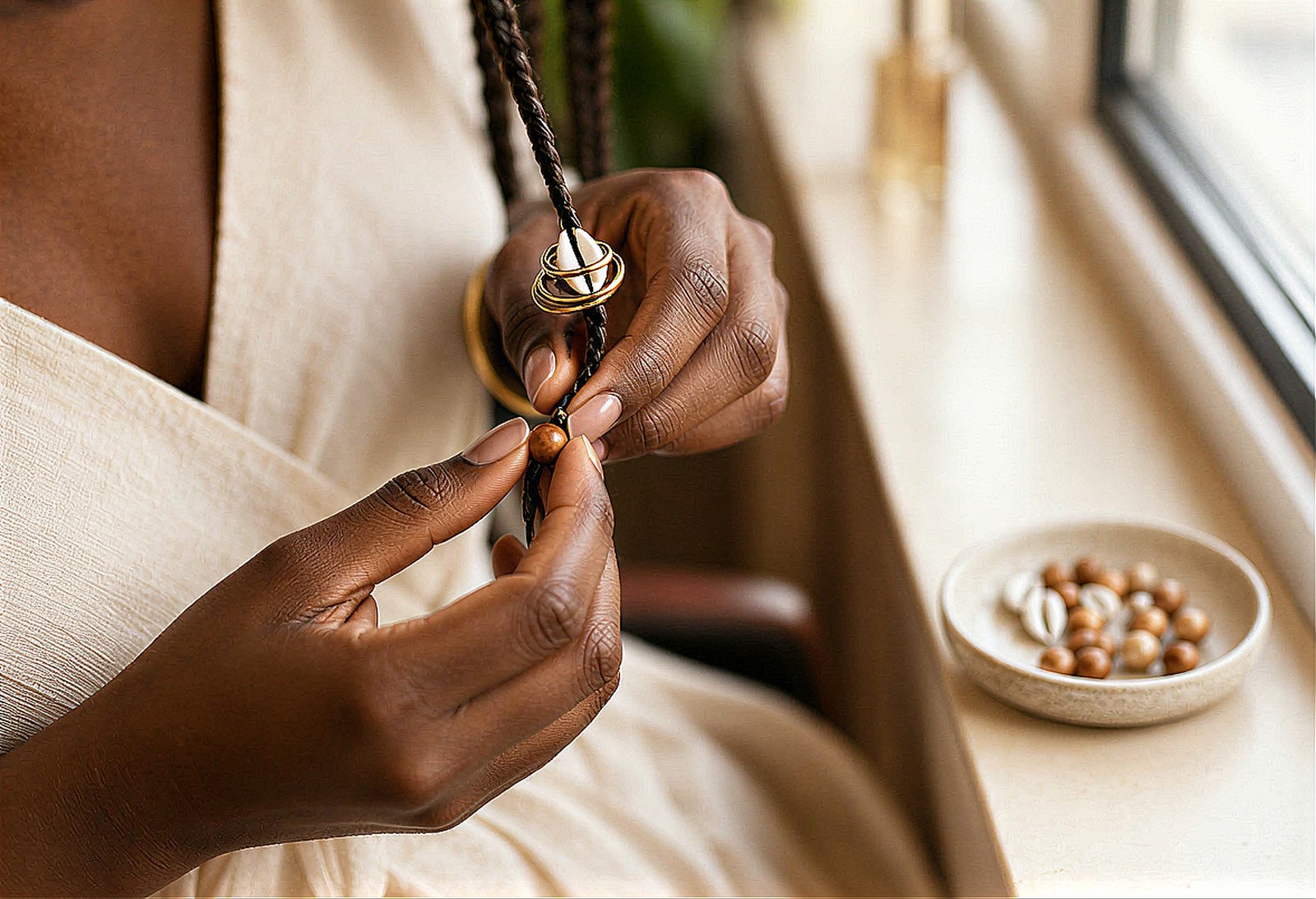
Beads are part of the adornment, and heavier bead choices create more scalp tension (Unruly).
Wooden beads are heavier and create more scalp tension; plastic beads are lighter and can be layered by colour (Unruly). Match gold, amber, brown, turquoise, clear or muted earth tones to your jewellery and fabric rather than mixing everything at once. Loose beads can be re-secured with small rubber bands or bead stoppers without redoing the braid (Aunt Jackie’s).
Cowrie shells carry different meanings across West African cultures, and the sources are thin. One museum label reads them as a symbol of abundance and prosperity on a Fulani-attributed basket that is only possibly Fulani (SUNY New Paltz). Treat that as one reading among many, not a definition, and ask before wearing them symbolically.
Whether beads are included varies: some braiders include them, others charge separately or ask you to bring your own (Fulani Braids Cost). Confirm before the appointment, not at the chair.
Which hair to buy and how to prepare for the chair
Pack counts depend on length, density, braid size and whether curls are added, so the honest answer is to ask your braider and then buy.
Classic braids vs curly ends
Pre-stretched synthetic such as X-Pression is one option for the braided back. X-Pression is 100% Kanekalon fibre and withstands up to 180°C for hot-water setting (Nakuru Locks and Braiding). For curls, use curly human hair or curly extensions — human and virgin hair cost more than synthetic (Fulani Braids Cost). If synthetic fibre itches, soak it first: one part apple cider vinegar to three parts water for 20 minutes, until a white film appears, then rinse and dry (Nakuru Locks and Braiding).
How many packs do you need?
The X-Pression braiding hair guide publishes counts for a full head of medium braids: 3–4 packs of 38–42″ pre-stretched hair for shoulder to mid-back, 4–6 packs of 50–52″ for waist, and 5–8 packs of 58–72″ for butt or thigh length (Nakuru Locks and Braiding). A standard pack is usually 3–4 ounces (Unruly).
Source: Nakuru Locks and Braiding — X-Pression Braiding Hair Guide, April 2026
One braiding-hair guide gives two different Fulani counts on the same page, 2–3 packs and 4–6 packs (Unruly). That is exactly why the braider, not a blog, should set the number.
A five-line booking message
- Style: Fulani braids with one central cornrow, two side cornrows each side and box braids at the back.
- Length and size: mid-back, medium braid size.
- Finish: curly ends yes or no; beads included, extra, or brought by me.
- Hair: how many packs, which brand, and is hair in the price.
- Booking: requested date, total price, deposit and expected chair time.
Prep is simple: wash, detangle, apply leave-in and stretch or blow-dry if the braider asks (Aunt Jackie’s). Bring photos from the front, side and back, and skip heavy products that flake at the parting.
How long do Fulani braids last?
Four to six weeks is the range Unruly publishes before takedown or a refresh, with smaller braids lasting longer than jumbo ones (Unruly). A braiding-hair brand puts wear at 4–8 weeks with proper care (Nakuru Locks and Braiding). Growth, tension, scalp health and daily habits move you inside that window.
A realistic wear calendar
- First 48 hours: keep the style dry and hands-off, and wear a shower cap so steam stays off the parts (Ultimate Braiding).
- Weeks 1–2: cleanse the scalp gently, then dry the roots completely.
- Refresh the front and perimeter if the roots loosen rather than starting over (Ywigs).
- Weeks 6–8: book takedown; the X-Pression guide puts wear at up to eight weeks with proper care, and styles should not stay in until the roots tangle (Unruly).
Washing and bedtime routine
Wash in sections with diluted shampoo or a scalp cleanser, keep it on the scalp, rinse with gentle pressure and skip scrubbing the length (Unruly). Dry the scalp fully, because damp roots invite frizz and irritation and you should never sleep on a wet scalp (Ultimate Braiding). Light oil or braid spray two to three times a week beats heavy grease, and a satin bonnet plus a loose bundle for long braids limits friction (Ultimate Braiding).
When to take them down
Contact the braider at the first sign of sharp pain, bumps or worsening itch rather than pushing through for an event (Ultimate Braiding). Dermatologists advise against tightly pulled cornrows and braids, and repeated pulling can cause traction alopecia, which can become permanent (American Academy of Dermatology). Give your hair a rest period between installs (American Academy of Dermatology; Unruly).
What Fulani braids cost in Ghana and the US
A typical US full set runs $100–$350, while New York City sits at $200–$450+ and smaller US cities at $100–$200 (Fulani Braids Cost). A second source puts the national range at $170–$500+, with city, size, length and hair inclusion explaining the spread (Unruly; Fulani Braids Cost). For Ghana, the sources checked for this guide carry no dated cedi quote, so ask for a written breakdown rather than trusting a number from a comment thread.
Ghana price checklist
No named Accra or Kumasi salon quote, and no dated hair-pack price, appeared in the sources for this guide, and this site only prints prices it can date and credit (how prices are sourced and braiders credited). Ask for these instead:
- The price with hair included, and the price for labour only.
- The hair-pack cost separately, with the brand named.
- Salon chair price versus a home braider or mobile call-out.
- Curly ends, beads and cowries, and whether the labour to attach them is extra.
- Expected chair time, deposit amount and cancellation terms.
Get the cedi figure in writing on the day you book, because the quote moves with length, size and whether hair is included.
US price checklist
US quotes vary by city, braid size, length, complexity, hair inclusion and add-ons.
| Market | Published range | Notes | Checked |
|---|---|---|---|
| US typical full set | $100–$350 | Standard install | November 2026 |
| New York City | $200–$450+ | Higher for detailed or waist-length sets | November 2026 |
| Los Angeles | $180–$400 | Stylist and area dependent | November 2026 |
| Chicago | $150–$300 | Another source puts the Midwest at $120–$250 | November 2026 |
| Houston / Charlotte | $120–$250 | — | November 2026 |
| Smaller cities and towns | $100–$200 | Independent braiders and small salons | November 2026 |
| Mobile stylists | $275–$375 | Same quote in LA, NYC and DC | November 2026 |
Source: Fulani Braids Cost — 2026 Price Guide by City & Style, Updated August 2026
Budget beyond the install. Deposits are usually non-refundable and deducted from the final total (Fulani Braids Cost), and a 15–20% tip is the US norm (Unruly).
- Booking depositusually non-refundable and deducted from the final total
- Professional takedownsold as a separate add-on
Source: Fulani Braids Cost — 2026 Price Guide by City & Style, Updated August 2026
What the quote should include
- Hair, or a clear statement that extension hair is bought separately (Booksy).
- Prep, since a wash and blow-out is often an add-on.
- Installation, with length, size and parting pattern agreed in writing.
- Curls, beads, cowries and the labour to attach them.
- Chair time, deposit, lateness, cancellation and any fix window.
- Aftercare advice, and whether a paid takedown is available.
How to book a braider without surprises
Ask for recent photos of the braider’s own work, especially the front section pattern and the back finish, and choose the portfolio over the cheapest quote (Unruly).
Questions to ask before you pay a deposit
- What is the total, and what exactly does it cover?
- How many packs of which brand, and is hair included?
- How long will the appointment take?
- What are the deposit, lateness and cancellation terms in writing?
- What is the window for reporting a problem?
Named policies give you a benchmark. One salon refunds a deposit in full with at least 24 hours’ notice and asks that problems be reported within two days (Forney Luxury Hair Braiding). Deposit and cancellation rules differ by country, so ask which consumer law applies to your booking (The Hair and Beauty Directory).
Red flags to walk away from
- No photos of the braider’s own work.
- A price that stays vague after you give length and size.
- Refusal to confirm hair quantities or brand.
- Pressure to go smaller or tighter than you asked.
- No aftercare advice, and no answer on what happens if the parting lifts.
In Illinois, hair braiding is a regulated profession with its own Hair Braider licence, and you can check a professional in the state’s public licence lookup (IDFPR).
Common mistakes, tension and cultural respect
One mistake to avoid is treating tightness as quality. A correct install is secure but never painful, and a braider should stop before the hairline shows white bumps (Nakuru Locks and Braiding).
Protect your edges
Very small braids, heavy chunky sections and thick bead clusters all add pull, especially on fine hair. Dermatologists advise against tightly pulled cornrows and braids because repeated pulling can cause traction alopecia, and that hair loss can become permanent (American Academy of Dermatology). Take the style down at the first sign of persistent pain, and rest the hair between installs.
If you are not Fulani
Wear it with credit: name it Fulani braids rather than presenting it as a new trend, and point to where the pattern comes from. If you want cowrie shells for symbolic reasons, ask first, because meanings vary across communities. Fulani braids suit every face shape and budget, and the style reads better when the history travels with it.
What this means for you
Fulani braids are a section pattern you can specify, a price you can itemise and a protective style that lasts for weeks when tension and aftercare are right. Decide the back finish first, then size and length, then hair and adornment, and comparing quotes becomes straightforward.
Your final Fulani braids checklist
- Two or three photos showing the same parting, length and finish Save
- Hair, curls, beads and tip Budget
- Total price, hair packs, chair time and deposit Confirm in writing
- Deposit, lateness and cancellation terms Read before paying
- Appointment date with a buffer before the wedding or outdooring Book
- Satin bonnet and light scalp oil Ready at home
Next step: message two braiders with the five-line booking message above and compare what each quote includes, not just the total. If you are booking in Ghana, Ghana Directory lists salons and braiders you can contact directly.
Ghana Directory
Search salons and braiders, then confirm the quote, hair packs and chair time before paying a deposit.
More ideas on Pinterest
See more photos of these looks on Pinterest.
- Fulani braids styles on Pinterest
- Fulani braids with beads on Pinterest
- Ghanaian fulani braids on Pinterest
- Fulani braids with curls on Pinterest
- Short fulani braids on Pinterest
- Men’s fulani braids on Pinterest
Sources
- How To Do Fulani Braids: A Step-by-Step Guide — Aunt Jackie’s
- Fulani braids — Wikipedia
- Fulani Braid Hairstyles: The Ultimate Guide to Styles, Sizes & Lengths — Unruly
- Cost of Fulani Braids: NYC to LA, How Much Is Too Much? — Unruly
- How Much Hair Should I Buy? — Unruly
- Fulani Braids Cost — 2026 Price Guide by City & Style
- Fulani Braids Guide: Styles, Care, Installation, and Trends — Ywigs
- X-Pression Braiding Hair Guide — Nakuru Locks and Braiding
- African Braiding Near Me — Booksy
- Fulani Cornrow Mid Back: Aftercare for 2 Weeks — Ultimate Braiding Clinton
- Hair loss: Tips for managing — American Academy of Dermatology
- Fulani Basket — Samuel Dorsky Museum of Art, SUNY New Paltz
- Salon Policies — Forney Luxury Hair Braiding
- Refund and Returns Policy — Cozy Braids
- Can a Salon Charge for Missed Appointments? — The Hair and Beauty Directory
- Hair Braiding — Illinois Division of Professional Regulation
Frequently asked questions
What exactly are Fulani braids?
Fulani braids are a cornrow-based West African style with one central braid running from the front hairline to the nape, side cornrows angled away from the centre line, and free-hanging braids at the back. Length, thickness, curls and beads are choices added on top of that structure.
How much do Fulani braids cost?
In the US, a typical full set runs $100–$350, with New York City at $200–$450+ and smaller cities at $100–$200 (checked November 2026). The sources checked for this guide carry no dated Ghanaian cedi quote, so ask a braider for a written breakdown covering hair, curls, beads, chair time and deposit.
How long do Fulani braids last?
Unruly puts wear at four to six weeks before takedown or a refresh, and the X-Pression guide puts wear at up to eight weeks with proper care. Smaller braids last longer than jumbo ones, and growth, tension, scalp health and aftercare all move the timeline.
Which hair is best for Fulani braids?
Pre-stretched synthetic hair such as X-Pression, a Kanekalon fibre, is one option for the braided back. For Fulani braids with curls, use curly human hair or curly extensions at the ends, which cost more than synthetic.
Can men wear Fulani braids?
Yes. Men wear the same map with a centre part, smaller side cornrows and a braided or loose back. The sources checked give no men’s pricing, so ask for a quote on your own length and size.